
Comparison Canon EOS C100 Mark II vs Canon EOS C100
Add to comparison | 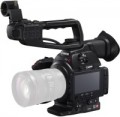 | 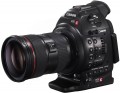 |
|---|---|---|
| Canon EOS C100 Mark II | Canon EOS C100 | |
from $2,699.00 | from $493.50 | |
| TOP sellers | ||
| Features | professional | professional |
| Media type | flash (memory card) | flash (memory card) |
Sensor | ||
| Sensor type | CMOS | CMOS |
| Sensor size | APS-C | APS-C |
| Number of megapixels | 9.84 | 9.84 |
| Effective megapixels | 8.29 | 8.29 |
Camera lens | ||
| Interchangeable lens |  | |
| Bayonet (mount) | Canon EF | Canon EF |
| Manual focus | | |
Video shooting | ||
| Video resolution | 1920x1080 px | 1920x1080 px |
| Frame frequency | 30 fps | 30 fps |
| Recording formats | MPEG-4 AVC/H.264 | MPEG-4 AVC/H.264 |
| Video recording speed | 28 Mbps, 24 Mbps, 17 Mbps | 24 Mbps, 17 Mbps, 7 Mbps |
| Minimum illuminance | 0.25 lux | 0.25 lux |
| Shutter speed | 1/3 — 1/2000 с | 1/3 — 1/2000 с |
| White balance | auto, Kelvin settings (range: 2000K to 15000K) | auto, Kelvin settings (range: 2000K to 15000K) |
| Pre-recording (Pre-Rec) | | |
| Sound recording | PCM 16bit (2ch, 48kHz) | PCM 16bit (2ch, 48kHz) |
Photo | ||
| Picture while shooting | |  |
Screen | ||
| Screen size | 3.5 " | 3.5 " |
| Screen resolution | 1230 K pixels | 922 K pixels |
Features | ||
| Features | viewfinder hot shoe detachable microphone | viewfinder hot shoe detachable microphone |
Memory and sockets | ||
| Memory card support | SD, SDHC | SD, SDHC |
| Memory card slots | 2 | 2 |
| Connectors | USB HDMI AV output microphone input XLR microphone input headphone jack | USB HDMI AV output microphone input XLR microphone input headphone jack |
Battery | ||
| Battery type | BP-955 | BP-955 |
| Battery capacity | 4900 mAh | 4900 mAh |
| Battery life | 4.58 h | 4.45 h |
General | ||
| Dimensions (WxHxD) | 188x280x334 mm | 185x281x236 mm |
| Weight | 1950 g | 1835 g |
| Color | ||
| Added to E-Catalog | april 2017 | november 2012 |


Compare Canon EOS C100 Mark II and C100
You may be interested in
My comparisons
Canon EOS C100 Mark II often compared


Canon EOS C100 often compared


Glossary
Video recording speed
The data transfer speed provided by the camera when recording video. This parameter is also called bitrate (i.e., the number of bits per unit of time). For any file format used for recording, the general rule is that the higher the bitrate, the better the image quality (especially for formats that use lossy compression). On the other hand, high speed have appropriate requirements for the capabilities of the memory cards used — for more details, see "Memory card support"; and it increases the size of the file accordingly. Therefore, many modern camcorders are able to work with different bitrates; this allows you to choose the best option depending on what is more important for you at the moment — maximum quality or the ability to work with a slow card.
At the same time, we note that in terms of quality, this parameter is important mainly for professional video shooting. If you need a camera for amateur purposes, there is no need to look for the maximum bitrate: after all, such models (and memory cards for them) cost accordingly.
At the same time, we note that in terms of quality, this parameter is important mainly for professional video shooting. If you need a camera for amateur purposes, there is no need to look for the maximum bitrate: after all, such models (and memory cards for them) cost accordingly.
Picture while shooting
Possibility of taking photos during video recording. Usually it is implemented by a separate button, when pressed, the camera captures the visible image as a photo without interrupting video recording.
Of course, modern technologies allow you to save individual frames from an already finished video, but simultaneous photography compares favorably in two ways. Firstly, the resolution of the “picture” in photo mode is often higher than in video recording, and secondly, the procedure of processing a photo differs from the method for processing video frames and allows you to get a better image. So if you need the ability to highlight individual moments in the filmed events, it makes sense to choose a model with this function.
Of course, modern technologies allow you to save individual frames from an already finished video, but simultaneous photography compares favorably in two ways. Firstly, the resolution of the “picture” in photo mode is often higher than in video recording, and secondly, the procedure of processing a photo differs from the method for processing video frames and allows you to get a better image. So if you need the ability to highlight individual moments in the filmed events, it makes sense to choose a model with this function.
Battery life
The battery life of the camcorder from a fully charged standard battery. Usually, the specifications indicate the battery life in the recording mode, but in perfect conditions — without using additional features such as zoom, backlight, etc., which also “eat up” the charge. And if there is a viewfinder (see "Features"), the shooting time is usually indicated through this device, and not through an external display. Therefore, in fact, the battery life may be less, but in general, this parameter quite clearly describes the capabilities of a particular camera, and different models can be compared by it.
Note that for many cameras, in addition to regular ones, also “reinforced” batteries are produced, which allow increasing battery life by 2-3 times. Therefore, if you are not satisfied with the operating time in the selected model, it makes sense to ask about the availability of such batteries.
Note that for many cameras, in addition to regular ones, also “reinforced” batteries are produced, which allow increasing battery life by 2-3 times. Therefore, if you are not satisfied with the operating time in the selected model, it makes sense to ask about the availability of such batteries.