
Comparison LDNIO SC3412 vs LDNIO SC3604
Add to comparison | 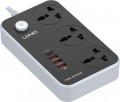 | 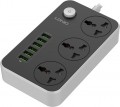 |
|---|---|---|
| LDNIO SC3412 | LDNIO SC3604 | |
| Outdated Product | Outdated Product | |
| TOP sellers | ||
Quick Charge 3.0. Power Delivery 3.0. | ||
| Product type | surge protector | surge protector |
Specs | ||
| Cable length | 2 m | 2 m |
| Max. power | 2500 W | 2500 W |
| Max. load | 10 А | 10 А |
| Wire section | 0.75 mm² | 0.75 mm² |
| Operation indicator |  | |
| Power switch | general | general |
Connection | ||
| Plug type | on camera flashes | on camera flashes |
| International plug | 3 | 3 |
| USB-A | 3 pcs | 6 pcs |
| USB-C | 1 pcs | |
| Max. charging current | 3 А | |
| Power (with 1 device) | 15 W | |
| Charge current | 3.4 А | |
| Power (all ports) | 17 W | |
| Protection | short circuit overload automatic fuse | short circuit overload automatic fuse |
Design features | ||
| Safety socket cover | | |
| Socket plugs | parallel to body (180°) | parallel to body (180°) |
| Size | 160x97x33 mm | 180x100x37 mm |
| Weight | 450 g | 245 g |
| Color | ||
| Added to E-Catalog | february 2022 | february 2022 |


Compare LDNIO SC3412 and SC3604
You may be interested in
LDNIO SC3412 often compared


Glossary
USB-A
Number of USB-A ports for charging included in the power strip design.
These ports don't serve any other function than powering and charging external devices, such as smartphones or tablets. Having such connectors in a power strip can be especially convenient when a "230-to-USB" adapter is not available, and there are few USB ports on a computer or laptop, making their use for charging a "luxury you can't afford."
These ports don't serve any other function than powering and charging external devices, such as smartphones or tablets. Having such connectors in a power strip can be especially convenient when a "230-to-USB" adapter is not available, and there are few USB ports on a computer or laptop, making their use for charging a "luxury you can't afford."
USB-C
Number of USB-C ports in the power strip design.
These ports serve no other function than powering and charging external devices, such as smartphones or tablets. Having such connectors in a power strip can be especially convenient when a "230-to-USB" adapter is not available, and there are few USB ports on a computer or laptop, making it a "luxury" to use them for charging.
These ports serve no other function than powering and charging external devices, such as smartphones or tablets. Having such connectors in a power strip can be especially convenient when a "230-to-USB" adapter is not available, and there are few USB ports on a computer or laptop, making it a "luxury" to use them for charging.
Max. charging current
The current output by a USB connector when a charging gadget is connected to it.
The higher the current, the faster the battery can charge. However, when choosing, note that in order to use a high current strength, the connected device must also support it. Basically there are USB with a current strength of 2.1 A, 2.4 A and 3 A.
It is also worth noting that when using several USB ports at the same time, the current strength is significantly reduced.
The higher the current, the faster the battery can charge. However, when choosing, note that in order to use a high current strength, the connected device must also support it. Basically there are USB with a current strength of 2.1 A, 2.4 A and 3 A.
It is also worth noting that when using several USB ports at the same time, the current strength is significantly reduced.
Power (with 1 device)
The maximum power that a USB port can produce when connecting only one gadget.
Higher power output speeds up the charging process. At the same time, there are a number of nuances associated with this parameter. Firstly, the appropriate power must be supported not only by the port, but also by the gadget being charged - otherwise the speed of the process will be limited by the characteristics of the gadget. Secondly, to take full advantage of the capabilities, you may need to support not only the appropriate charging power, but also a specific fast charging technology. Thirdly, in filters with several charging connectors, the maximum power per device can only be achieved if the other ports are not used.
Higher power output speeds up the charging process. At the same time, there are a number of nuances associated with this parameter. Firstly, the appropriate power must be supported not only by the port, but also by the gadget being charged - otherwise the speed of the process will be limited by the characteristics of the gadget. Secondly, to take full advantage of the capabilities, you may need to support not only the appropriate charging power, but also a specific fast charging technology. Thirdly, in filters with several charging connectors, the maximum power per device can only be achieved if the other ports are not used.
Charge current
Current value for all USB ports of the device. Allows you to understand how much maximum you can squeeze out of the device, i.e. how much current will be supplied to each port at maximum load. As for the maximum value of the current strength, it cannot be determined by this indicator.
Power (all ports)
The total power provided by the device when charging through all USB ports simultaneously.
When assessing this parameter, two points should be taken into account. Firstly, when fully loaded, the power of each individual port may be below the maximum possible value. For example, some models with 2 USB ports of 3 A and 2 A (15 W and 10 W), with both ports operating simultaneously, can output only 10 W per each, that is, only 20 W in total (this is the number indicated at this point). Secondly, the power distribution across individual connectors may be different, depending on the current on each port and the supported fast charging technologies; It is best to clarify these nuances using official documentation.
When assessing this parameter, two points should be taken into account. Firstly, when fully loaded, the power of each individual port may be below the maximum possible value. For example, some models with 2 USB ports of 3 A and 2 A (15 W and 10 W), with both ports operating simultaneously, can output only 10 W per each, that is, only 20 W in total (this is the number indicated at this point). Secondly, the power distribution across individual connectors may be different, depending on the current on each port and the supported fast charging technologies; It is best to clarify these nuances using official documentation.