
Comparison BERNINA Bernette B35 vs BERNINA Bernette B33
Add to comparison | 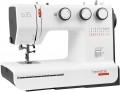 | 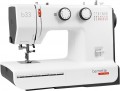 |
|---|---|---|
| BERNINA Bernette B35 | BERNINA Bernette B33 | |
from $399.00 | Compare prices 1 | |
| TOP sellers | ||
| Type of sewing machine | electromechanical | electromechanical |
| Shuttle | oscillating | oscillating |
| Loop formation | automatic | semi-automatic |
Technical specs | ||
| Number of stitches | 23 | 15 |
| Max. stitch length | 4 mm | 4 mm |
| Max. stitch width | 5 mm | 5 mm |
| Max. presser foot height | 10 mm | |
| Sewing speed | 860 st/min | 860 st/min |
Features | ||
| Features | reverse stitching free arm needle threader | reverse stitching free arm needle threader |
Adjustment options | ||
| Adjustments | thread tension | thread tension |
Included presser feet | ||
| Presser foots | universal foot zipper foot blind hem foot button sewing foot buttonhole foot | universal foot zipper foot blind hem foot button sewing foot buttonhole foot |
More specs | ||
| Power source | power through mount | power through mount |
| Power consumption | 85 W | 85 W |
| Ruler on body |  | |
| Added to E-Catalog | april 2017 | april 2017 |



Compare BERNINA Bernette B35 and Bernette B33
Sewing machines BERNINA Bernette B35 and BERNINA Bernette B33 are electromechanical models with a swinging hook. The main difference lies in the number of stitches: B35 offers 23 stitches, whereas B33 only has 15 stitches. The buttonhole formation on the B35 is automatic, while on the B33 it is semi-automatic. Both devices have the same maximum stitch length (4 mm) and width (5 mm), as well as a sewing speed of up to 860 stitches/min. The set includes identical presser feet, and both machines have a thread tension regulator. The power consumption is 85 W for both models.
Price comparison
You may be interested in
BERNINA Bernette B35 often compared


BERNINA Bernette B33 often compared

Glossary
Loop formation
A method of forming slotted loops supported by a machine.
— Automatic. Fully automatic buttonhole sewing mode; the user only needs to set the length, after which the machine will independently process the edges of the future loop, without the need to switch modes manually. The most convenient and advanced option; It is the automatic method that is recommended if you plan to sew a large number of loops.
— Semi-automatic. When forming a loop in this way, the work is done in 2 or 4 steps. For example, in the first case, the machine makes one short bartack and one long longitudinal stitch in one pass, then the mode switches and a second bartack and a second long stitch are performed; in the second case, accordingly, you have to switch between 4 stages. Such work takes more time than automatic loop formation, but such machines are cheaper.
— Automatic. Fully automatic buttonhole sewing mode; the user only needs to set the length, after which the machine will independently process the edges of the future loop, without the need to switch modes manually. The most convenient and advanced option; It is the automatic method that is recommended if you plan to sew a large number of loops.
— Semi-automatic. When forming a loop in this way, the work is done in 2 or 4 steps. For example, in the first case, the machine makes one short bartack and one long longitudinal stitch in one pass, then the mode switches and a second bartack and a second long stitch are performed; in the second case, accordingly, you have to switch between 4 stages. Such work takes more time than automatic loop formation, but such machines are cheaper.
Number of stitches
The number of stitches that a sewing machine can sew. The larger this number, the more extensive the capabilities of this model, the wider the choice the user has; however, it wouldn’t hurt to clarify the specific range of supported stitches separately.
The fewest options - mostly up to 25 - are provided in electromechanical machines, as well as specialized devices such as overlockers and carpet lockers (see “Type”). In computer-controlled devices, the number of lines can be in the dozens, and some also allow you to download additional options from the computer.
The fewest options - mostly up to 25 - are provided in electromechanical machines, as well as specialized devices such as overlockers and carpet lockers (see “Type”). In computer-controlled devices, the number of lines can be in the dozens, and some also allow you to download additional options from the computer.
Max. presser foot height
Distance from the working surface to the foot in the uppermost position. Must be taken into account when working with thick fabrics.