
Comparison Gamemax Defender Mesh black vs Gamemax Destroyer Mesh black
Add to comparison | 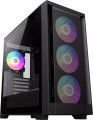 | 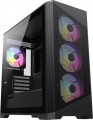 |
|---|---|---|
| Gamemax Defender Mesh black | Gamemax Destroyer Mesh black | |
from $59.99 | from $50.99 | |
| User reviews | ||
| TOP sellers | ||
| Features | gaming | gaming |
| Form factor | Mini Tower | Mini Tower |
| Mount | vertical | vertical |
| Motherboard support | micro-ATX | micro-ATX |
| Board placement | vertical | vertical |
| PSU form factor | ATX (regular) | ATX (regular) |
Computer case | ||
| Dimensions (HxWxD) | 450x210x461 mm | 450x210x461 mm |
| PSU max lenght | 265 mm | 265 mm |
| Graphics card max lenght | 410 mm | 410 mm |
| Fan max height | 165 mm | 165 mm |
| Material | steel | steel |
| Sidewall thickness | 0.6 mm | 0.6 mm |
| Lighting type | backlit fan | backlit fan |
| Lighting colour | ARGB | FRGB |
| Lighting sync | multi compatibility | |
| Side panel | removable | removable |
Storage | ||
| PSU |  | |
| PSU mount | bottom | bottom |
| 3.5" bays | 2 | 2 |
| internal 2.5" compartments | 2 | 2 |
| Expansion slots | 5 | 5 |
Cooling | ||
| Installed fans | 4 шт 120 mm | 4 шт FN-FF12X |
| Fans (back) | 1x120mm | 1x120mm |
| Fans (front) | 2x140mm | 2x140mm |
| Fans (side) | 2x120mm | 2x120mm |
| Fans (top) | 2x140mm | 2x140mm |
| Fans (bottom) | 2x120mm | 2x120mm |
| Fan mounts total | 11 | 11 |
| Dust filter | bottom, top and side | bottom, top and side |
| Liquid cooling system support |  | |
Liquid cooling system | ||
| Liquid cooling (rear) | 120 mm | 120 mm |
| Liquid cooling (front) | 360 mm | 360 mm |
| Liquid cooling (side) | 240 mm | 240 mm |
| Liquid cooling (top) | 360mm | 360mm |
| Liquid cooling mounts | 4 | 4 |
Connectors and functions | ||
| Placement | on top of the case | on top of the case |
| USB-A 2.0 | 2 pcs | 2 pcs |
| USB-A 5Gbps | 1 pcs | 1 pcs |
| Audio (microphone/headphones) | | |
More features | ||
| Front panel | lattice | lattice |
| Side panel window | tempered glass | tempered glass |
| More features | removable HDD cage hidden wiring CPU cooling mount window | removable HDD cage hidden wiring CPU cooling mount window |
| Color | ||
| Added to E-Catalog | july 2023 | july 2023 |


Compare Gamemax Defender Mesh and Destroyer Mesh
You may be interested in
My comparisons
Gamemax Defender Mesh often compared

Glossary
Lighting colour
For more on decorative lighting in general, see Light Type above. Here we note that it can have different shades, and sometimes several options are indicated in the characteristics at once. If these options are listed through "and" (for example, "red, blue and green") — this means that this model contains all the specified colours, and the user can switch between them at his discretion. If the shades are listed through “or” (for example, “red, blue or green”), this means that this model is available in several versions that differ in the colour of the backlight.
Special mention is the "RGB" option. This is the name of the most advanced backlight, the shade of which can be chosen at your discretion. However the original RGB backlighting is capable of simultaneously displaying only one of several basic colours (white, yellow, green, red, blue or purple); nevertheless, even these possibilities are enough to customize the appearance of the case and apply various effects (such as backlight synchronization — see below).
And relatively recently, an even more advanced type of adjustable systems has appeared — ARGB backlight. The key difference between ARGB and classic RGB is the possibility of simultaneous operation of diodes of different colours. In other words, classic RGB lighting can display only one colour at a time, while ARGB can display several colours, which provides additional effects. Also, ARGB lighting is connecte...d using a 3pin 5v connector, while regular RGB uses a 4pin 12v connection. It can be represented by various types of illumination. So, ARGB is often integrated into the cooling system, the front panel and magnetic LED strips, which the user can mount at his discretion. To control the backlight, a special controller is usually provided, and buttons or controls for switching the illumination operation modes are placed on the interface panel. In some cases, the backlight is controlled by the motherboard, through a special connector. Many ARGB systems support the ability to fine-tune through specialized software.
Special mention is the "RGB" option. This is the name of the most advanced backlight, the shade of which can be chosen at your discretion. However the original RGB backlighting is capable of simultaneously displaying only one of several basic colours (white, yellow, green, red, blue or purple); nevertheless, even these possibilities are enough to customize the appearance of the case and apply various effects (such as backlight synchronization — see below).
And relatively recently, an even more advanced type of adjustable systems has appeared — ARGB backlight. The key difference between ARGB and classic RGB is the possibility of simultaneous operation of diodes of different colours. In other words, classic RGB lighting can display only one colour at a time, while ARGB can display several colours, which provides additional effects. Also, ARGB lighting is connecte...d using a 3pin 5v connector, while regular RGB uses a 4pin 12v connection. It can be represented by various types of illumination. So, ARGB is often integrated into the cooling system, the front panel and magnetic LED strips, which the user can mount at his discretion. To control the backlight, a special controller is usually provided, and buttons or controls for switching the illumination operation modes are placed on the interface panel. In some cases, the backlight is controlled by the motherboard, through a special connector. Many ARGB systems support the ability to fine-tune through specialized software.
Lighting sync
The timing technology provided in the illuminated housing (see “Light Type”).
Synchronization itself allows you to "match" the backlight of the case with the backlight of other system components — the motherboard, graphics card, keyboard, mouse, etc. Thanks to this matching, all components can change colour synchronously, turn on / off at the same time, etc. It is worth noting that all such systems have RGB backlighting. The specific features of the operation of such a backlight depend on the synchronization technology used, and, usually, each manufacturer has its own (Mystic Light Sync for MSI, Aura Sync for Asus, etc.). The compatibility of the components also depends on this: they must all support the same technology. So the easiest way to achieve backlight compatibility is to collect components from the same manufacturer.
Synchronization itself allows you to "match" the backlight of the case with the backlight of other system components — the motherboard, graphics card, keyboard, mouse, etc. Thanks to this matching, all components can change colour synchronously, turn on / off at the same time, etc. It is worth noting that all such systems have RGB backlighting. The specific features of the operation of such a backlight depend on the synchronization technology used, and, usually, each manufacturer has its own (Mystic Light Sync for MSI, Aura Sync for Asus, etc.). The compatibility of the components also depends on this: they must all support the same technology. So the easiest way to achieve backlight compatibility is to collect components from the same manufacturer.
Installed fans
The more fans are included in the design, all else being equal — the more intense the cooling will be and the more powerful (and, consequently, "hotter") components can be placed in the case without the risk of overheating. For everyday tasks, a case with one, two, three, or four factory fans is quite sufficient. At the same time, when comparing, it is worth considering not only the number but also the operating characteristics of the fans (diameter, speed). It should also be noted that cases are available for purchase without fans but with open slots for fans, allowing you to supplement the cooling system and improve its performance if necessary.