
Comparison Deepcool CK560 black vs Deepcool CG560 black
Add to comparison | 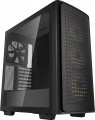 | 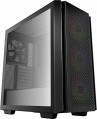 |
|---|---|---|
| Deepcool CK560 black | Deepcool CG560 black | |
from $68.99 | from $69.99 | |
| User reviews | ||
| TOP sellers | ||
| Features | gaming | gaming |
| Form factor | Midi Tower | Midi Tower |
| Mount | vertical | vertical |
| Motherboard support | E-ATX | ATX |
| Board placement | vertical | vertical |
| PSU form factor | ATX (regular) | ATX (regular) |
Computer case | ||
| Dimensions (HxWxD) | 471x230x456 mm | 470x230x452 mm |
| PSU max lenght | 160 mm | 160 mm |
| Graphics card max lenght | 380 mm | 380 mm |
| Fan max height | 175 mm | 175 mm |
| Weight | 8 kg | 7 kg |
| Material | steel | steel |
| Rubber feet |  | |
| Lighting type | backlit fan | backlit fan |
| Lighting colour | ARGB | ARGB |
| Lighting sync | multi compatibility | multi compatibility |
| Side panel | removable | removable |
Storage | ||
| PSU |  | |
| PSU mount | bottom | bottom |
| 3.5" bays | 2 | 2 |
| internal 2.5" compartments | 2 | 2 |
| Expansion slots | 7 | 7 |
Cooling | ||
| Installed fans | 4 шт 3x120mm, 1x140mm | 4 шт 3x120mm, 1x140mm |
| Fans (back) | 1x140mm | 1x140mm |
| Fans (front) | 2x140mm | 2x140mm |
| Fans (top) | 2x140mm | 2x140mm |
| Fan mounts total | 6 | 6 |
| Dust filter | front, top and bottom | + |
| Liquid cooling system support | | |
Liquid cooling system | ||
| Liquid cooling (rear) | 140 mm | 140 mm |
| Liquid cooling (front) | 360 mm | 360 mm |
| Liquid cooling (top) | 280mm | 280mm |
| Liquid cooling mounts | 3 | 3 |
Connectors and functions | ||
| Placement | on top of the case | on top of the case |
| USB-A 5Gbps | 2 pcs | 2 pcs |
| USB-C 5Gbps | 1 pcs | |
| Audio (microphone/headphones) | | |
More features | ||
| Front panel | lattice | lattice |
| Side panel window | tempered glass | tempered glass |
| More features | graphics card holder removable HDD cage hidden wiring CPU cooling mount window | hidden wiring CPU cooling mount window |
| Color | ||
| Added to E-Catalog | january 2022 | december 2021 |


Compare Deepcool CK560 and CG560
You may be interested in
My comparisons
Deepcool CK560 often compared


Deepcool CG560 often compared


Glossary
Motherboard support
The type of motherboard for which the design is designed. This parameter is indicated by the form factor of the "motherboard", under which the case is designed. The options might be:
— ATX. One of the most common types of motherboards today, the standard ATX size is 30.5x24.4 cm. It is used in both home and middle-class office PCs.
— XL-ATX. The general name for several standards of motherboards, united, as the name implies, by rather large sizes and corresponding equipment. Specific values for these dimensions can vary from 324 to 345 mm long and 244 to 264 mm wide, depending on the manufacturer and model. Accordingly, when choosing such a case, it is worthwhile to separately clarify its compatibility with a specific motherboard.
— E-ATX(Extended ATX). The largest type of motherboards, under which modern cases are made, has dimensions of 30.5x33 cm. It is usually used in high-performance systems that require numerous expansion slots.
— micro-ATX (m-ATX). The compact version of the ATX board has dimensions of 24.4x24.4 cm. The main scope of such boards is office systems that do not require high performance.
— mini-ITX. One of the further reductions in the form factor of motherboards after m-ATX assumes a board size of about 17x17 cm and one (most often) e...xpansion slot. Also designed for compact systems that do not differ in performance.
— Thin mini-ITX. A modification of the mini-ITX described above, designed to reduce the thickness of the case (up to 25 mm), and the RAM sticks do not protrude upwards and lie on the "motherboard" parallel to the board itself (for more details, see "Form factor"). Like most compact designs, thin mini-ITX boards do not have high processing power.
Note that most cases allow the installation of smaller motherboards — for example, many E-ATX cases can be used with ATX motherboards. However, specific compatibility anyway should be clarified separately.
— ATX. One of the most common types of motherboards today, the standard ATX size is 30.5x24.4 cm. It is used in both home and middle-class office PCs.
— XL-ATX. The general name for several standards of motherboards, united, as the name implies, by rather large sizes and corresponding equipment. Specific values for these dimensions can vary from 324 to 345 mm long and 244 to 264 mm wide, depending on the manufacturer and model. Accordingly, when choosing such a case, it is worthwhile to separately clarify its compatibility with a specific motherboard.
— E-ATX(Extended ATX). The largest type of motherboards, under which modern cases are made, has dimensions of 30.5x33 cm. It is usually used in high-performance systems that require numerous expansion slots.
— micro-ATX (m-ATX). The compact version of the ATX board has dimensions of 24.4x24.4 cm. The main scope of such boards is office systems that do not require high performance.
— mini-ITX. One of the further reductions in the form factor of motherboards after m-ATX assumes a board size of about 17x17 cm and one (most often) e...xpansion slot. Also designed for compact systems that do not differ in performance.
— Thin mini-ITX. A modification of the mini-ITX described above, designed to reduce the thickness of the case (up to 25 mm), and the RAM sticks do not protrude upwards and lie on the "motherboard" parallel to the board itself (for more details, see "Form factor"). Like most compact designs, thin mini-ITX boards do not have high processing power.
Note that most cases allow the installation of smaller motherboards — for example, many E-ATX cases can be used with ATX motherboards. However, specific compatibility anyway should be clarified separately.
Dust filter
The presence of a special filter in the housing to prevent dust from entering. Without such a filter, dust settles on the system elements; Radiators are especially susceptible to this; they also lose their efficiency by becoming clogged with dust. If you have a dust filter, you have to clean not the “filling” of the PC, but the filter element itself, which is much simpler and more convenient.
Compartments for dust filters can be located on the front panel of the case, back, bottom, top, or in the side walls. There are also case models with several technological niches for installing dust filters - the combined version assumes the presence of such compartments on several sides of the case at once.
Compartments for dust filters can be located on the front panel of the case, back, bottom, top, or in the side walls. There are also case models with several technological niches for installing dust filters - the combined version assumes the presence of such compartments on several sides of the case at once.
USB-C 5Gbps
Number of proprietary USB-C 5Gbps ports (formerly known as USB-C 3.2 gen1 and USB-C 3.0) provided in the case.
Such ports are usually located at the front (see "Location" for more details). They are most convenient for peripherals that need frequent connection and disconnection, such as flash drives (for permanently connected devices, it is more convenient to use motherboard ports located on the rear panel). Specifically, USB-C is a relatively new type of USB connector — smaller than the classic USB and with a reversible design. The application of such a connector can vary depending on the features of the motherboard: in particular, it can also be used as a Thunderbolt v3 port, and the 5Gbps connection interface is characterized by a bandwidth of up to 4.8 Gbps.
Such ports are usually located at the front (see "Location" for more details). They are most convenient for peripherals that need frequent connection and disconnection, such as flash drives (for permanently connected devices, it is more convenient to use motherboard ports located on the rear panel). Specifically, USB-C is a relatively new type of USB connector — smaller than the classic USB and with a reversible design. The application of such a connector can vary depending on the features of the motherboard: in particular, it can also be used as a Thunderbolt v3 port, and the 5Gbps connection interface is characterized by a bandwidth of up to 4.8 Gbps.
More features
— Front Cover. A flap cover that entirely or partially conceals the front panel. It gives the computer a neat appearance by hiding ports and external slots under a uniform surface and serves as childproof protection.
— Panel Display. A display on the front or side panel of the case used to show various service information: current CPU frequency, system temperature data, cooling mode, etc. Various important data can be displayed independently of what happens in the software part of the computer.
— Graphics Card Holder. A structural solution for supporting the graphics card inside the case. Specialized stands or holders prevent the graphics adapter from sagging over time and reduce the strain on the PCI-E slot of the motherboard. The fact is, many modern graphics card models have significantly increased in weight — holders are designed to compensate for their heaviness. Stands are available as built-in solutions or standalone accessories that can be installed inside the case independently.
— Side Panel Lock. A special lock on the removable side panel of the case. Such a lock prevents unauthorized access to the internal space of the system unit.
— Noise Insulation. The presence of additional noise insulation in the case. This can be a special coating on the interior sid...e or other, more specific solutions (e.g., damping systems on "mounting spots" for individual components, reducing the level of vibrations transmitted to the case). In any case, this feature helps reduce the noise level emitted by the system — sometimes quite significantly.
— Removable HDD Cage. The presence of a removable cage under the internal peripherals of 3.5" form factor (in most cases these are hard drives, hence the name) in the case design. This cage facilitates assembly because removing and installing a hard drive is much easier than securing it in a non-removable slot inside the case; this aspect is particularly useful if the system plans to install multiple hard drives.
— HDD Docking Station. Built-in docking station for quick connection of internal hard drives. In fact, this feature allows connecting an internal HDD as an external one: the docking station port is located outside the case and equipped with quick-connect fasteners for convenient connection.
— Hidden Cable Routing. The ability to route cables from the power supply on the reverse side of the motherboard (considering the main side where the processor and expansion card slots are located). Thus, the main "mobo" side is freed from cables, positively affecting cooling efficiency.
— Cooling System Installation Window (CS) for the processor. The presence of a separate window in the case opposite the CS mounts for the processor. The fastening system is located on the reverse side of the motherboard, and usually, replacing it requires removing the entire "mainboard"; the CS installation window frees the user from this necessity and significantly simplifies the installation and replacement of CS.
— Panel Display. A display on the front or side panel of the case used to show various service information: current CPU frequency, system temperature data, cooling mode, etc. Various important data can be displayed independently of what happens in the software part of the computer.
— Graphics Card Holder. A structural solution for supporting the graphics card inside the case. Specialized stands or holders prevent the graphics adapter from sagging over time and reduce the strain on the PCI-E slot of the motherboard. The fact is, many modern graphics card models have significantly increased in weight — holders are designed to compensate for their heaviness. Stands are available as built-in solutions or standalone accessories that can be installed inside the case independently.
— Side Panel Lock. A special lock on the removable side panel of the case. Such a lock prevents unauthorized access to the internal space of the system unit.
— Noise Insulation. The presence of additional noise insulation in the case. This can be a special coating on the interior sid...e or other, more specific solutions (e.g., damping systems on "mounting spots" for individual components, reducing the level of vibrations transmitted to the case). In any case, this feature helps reduce the noise level emitted by the system — sometimes quite significantly.
— Removable HDD Cage. The presence of a removable cage under the internal peripherals of 3.5" form factor (in most cases these are hard drives, hence the name) in the case design. This cage facilitates assembly because removing and installing a hard drive is much easier than securing it in a non-removable slot inside the case; this aspect is particularly useful if the system plans to install multiple hard drives.
— HDD Docking Station. Built-in docking station for quick connection of internal hard drives. In fact, this feature allows connecting an internal HDD as an external one: the docking station port is located outside the case and equipped with quick-connect fasteners for convenient connection.
— Hidden Cable Routing. The ability to route cables from the power supply on the reverse side of the motherboard (considering the main side where the processor and expansion card slots are located). Thus, the main "mobo" side is freed from cables, positively affecting cooling efficiency.
— Cooling System Installation Window (CS) for the processor. The presence of a separate window in the case opposite the CS mounts for the processor. The fastening system is located on the reverse side of the motherboard, and usually, replacing it requires removing the entire "mainboard"; the CS installation window frees the user from this necessity and significantly simplifies the installation and replacement of CS.