
Comparison Epson EcoTank L18050 vs Epson EcoTank L8050
Add to comparison | 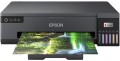 | 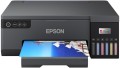 |
|---|---|---|
| Epson EcoTank L18050 | Epson EcoTank L8050 | |
| Outdated Product | from $499.00 | |
| TOP sellers | ||
| Print formats | A3 | A4 |
| Print type | inkjet | inkjet |
| Output type | colour | colour |
| Number of colors | 6 | 6 |
Print | ||
| Max. resolution | 5760х1440 dpi | 5760х1440 dpi |
| Mono print | 22 ppm | 22 ppm |
| Colour print | 22 ppm | 22 ppm |
| Photo print | 13 s/p | 12 s/p |
| CD print |  |  |
Printing supplies | ||
| Mono cartridge resource | 3600 page | 3600 page |
| Colour cartridge resource | 2100 page | 2100 page |
| Built-in CISS | | |
| Ink type | water soluble | water soluble |
Features | ||
| Data transfer | Wi-Fi 4 (802.11n) Wi-Fi Direct | Wi-Fi 4 (802.11n) Wi-Fi Direct |
| Cloud print | Epson iPrint | Epson iPrint |
| Screen | no display | no display |
Hardware | ||
| Grammage (min) | 64 g/m² | 64 g/m² |
| Grammage (max) | 300 g/m² | 300 g/m² |
General | ||
| Feed tray | 100 sheets | 100 sheets |
| Noise level | 48 dB | 37 dB |
| Power consumption | 19 W | 19 W |
| Dimensions (WxDxH) | 523x369x150 mm | 403x369x149 mm |
| Weight | 8 kg | 6 kg |
| Color | ||
| Added to E-Catalog | march 2023 | march 2023 |


Compare Epson EcoTank L18050 and L8050
Printers Epson L18050 and Epson L8050 have similar features, but there are key differences. L18050 supports paper size A3, while L8050 is limited to A4 size. Both devices use inkjet printing technology with a maximum resolution of 5760x1440 dpi and the same printing speed of 22 pages/min for black-and-white and color printing. However, L8050 offers the option to print on optical discs, which L18050 does not. The noise level of L8050 is 37 dB, which is significantly quieter compared to 48 dB for L18050. The weight of L18050 is 8 kg, whereas L8050 is lighter at 6 kg.
You may be interested in
Epson EcoTank L18050 often compared


Epson EcoTank L8050 often compared


Glossary
Print formats
The largest paper size that the printer can handle. Most often, the formats are marked from A0 to A10; it is from here that the famous “A4” is taken, denoting a standard landscape sheet. Modern printers can use the following formats:
A2 — 420x594, the size of a newspaper spread. The largest format used in today's consumer-grade printers. In fact, this size is rarely required, and the printers themselves are expensive; therefore models under A2 are usually high-end professional devices.
A3 — 297x420 mm (2 times larger than the landscape sheet, magazine spread). It is mainly used in the business area for printing large letterheads, brochures, announcements, posters, etc.
A4 — 210x297 mm, standard landscape sheet. The most common paper size for home and office use — usually this size is sufficient for non-specialized printing.
A6 — 105x148 mm (a quarter of the landscape sheet). Printers of this format are usually designed primarily for printing photographs — the sheet size is approximately equal to the size of a standard print of 10x15 cm.
A8 — 52x74 mm, an extremely miniature format, which is 1/16 of the popular A4 (comparable to the size of a standard business card — only a little shorter). It is found mainly among portable printers (see "Type"), including models with specific printing tech...nologies (on special paper without the use of dyes).
Note that the media format specified in the specifications is rather conditional: many printer models do not have length restrictions — the main thing is that the media fit into the width, and in some devices the actual maximum size is somewhat different from the standard sizes of a certain format.
A2 — 420x594, the size of a newspaper spread. The largest format used in today's consumer-grade printers. In fact, this size is rarely required, and the printers themselves are expensive; therefore models under A2 are usually high-end professional devices.
A3 — 297x420 mm (2 times larger than the landscape sheet, magazine spread). It is mainly used in the business area for printing large letterheads, brochures, announcements, posters, etc.
A4 — 210x297 mm, standard landscape sheet. The most common paper size for home and office use — usually this size is sufficient for non-specialized printing.
A6 — 105x148 mm (a quarter of the landscape sheet). Printers of this format are usually designed primarily for printing photographs — the sheet size is approximately equal to the size of a standard print of 10x15 cm.
A8 — 52x74 mm, an extremely miniature format, which is 1/16 of the popular A4 (comparable to the size of a standard business card — only a little shorter). It is found mainly among portable printers (see "Type"), including models with specific printing tech...nologies (on special paper without the use of dyes).
Note that the media format specified in the specifications is rather conditional: many printer models do not have length restrictions — the main thing is that the media fit into the width, and in some devices the actual maximum size is somewhat different from the standard sizes of a certain format.
Photo print
Printer print speed in photographic (highest) quality. Unlike other similar parameters, in this case the speed is usually indicated for a 10x15 sheet (A6, the most popular format for photographs). In addition, photo printing speed is not expressed in pages per minute, but in seconds per page, because. printing takes a lot of time. This option is worth paying attention to if you plan to print photos frequently.
CD print
Ability to use the printer to print directly on recordable optical discs (CD-R/RW, DVD-R/RW). Thus, after recording a disc, you can put on its non-working surface (non-mirror side used for inscriptions) an inscription or image as you wish. Often these printers come with software that makes it easy to create layouts for printing on disks. Please note that only specially designed discs can be used for printing.
Noise level
Approximate noise level generated by the printer during normal operation. The decibels in which the noise level is expressed is a non-linear value, so it is easiest to evaluate this indicator using comparative tables. The quietest printers give out about 35 dB — this is the volume of a conversation in a whisper, such noise will not stand out even in a quiet library reading room. A volume of 40 dB approximately corresponds to a conversation at an average volume, according to sanitary standards, this is the upper limit of permissible constant noise in residential premises during the day. For offices, the border is slightly higher — 55 – 60 dB, this is the volume of a conversation in raised tones. And the most powerful and heavy models give out up to 70 dB — this is comparable to a noisy city street; if such a printer is planned to be used frequently, it is advisable to install it in a separate room.
In general, lower noise levels make the device more comfortable to use, but may affect performance and/or price.
In general, lower noise levels make the device more comfortable to use, but may affect performance and/or price.