
Comparison Hisense 65E7KQ vs Hisense 65U7KQ
Add to comparison | 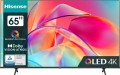 | 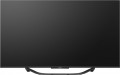 |
|---|---|---|
| Hisense 65E7KQ | Hisense 65U7KQ | |
from $899.00 | from $999.99 | |
| User reviews | ||
| TOP sellers | ||
| Size | 65 " | 65 " |
| Operating system | Smart TV (proprietary system) | Smart TV (proprietary system) |
Display | ||
| Matrix | QLED | QLED |
| Backlight type | Direct LED | Mini LED |
| Screen surface | anti-glare | glossy |
| Resolution | 3840x2160 px | 3840x2160 px |
| Upscaling | up to 4K | up to 4K |
| Brightness | 300 cd/m² | 500 cd/m² |
| Static contrast | 3 200:1 | 5 000:1 |
| Response time | 6 ms | |
| Frame rate | 50/60 Hz | 100/120 Hz |
| Frame rate (game mode) | 144 Hz | |
| HDR support | HDR10+, Dolby Vision | HDR10+, Dolby Vision |
| IMAX Enhanced |  |  |
| Brightness / contrast enhancement | | |
| Colour enhancement | | |
Multimedia | ||
| Sound power | 20 W | 40 W |
| Number of speakers | 2 | 2 |
| Subwoofer | | |
| Audio decoders | Dolby Atmos, DTS | |
| Digital tuner | DVB-T2 (terrestrial) DVB-C (cable) DVB-S (satellite) DVB-S2 (satellite) | DVB-T2 (terrestrial) DVB-C (cable) DVB-S (satellite) DVB-S2 (satellite) |
Features | ||
| Features | AirPlay 2 Wi-Fi 5 (802.11ac) Miracast Bluetooth voice control Google Assistant | AirPlay 2 Wi-Fi 5 (802.11ac) Miracast Bluetooth v5.1 |
Connectors | ||
| HDMI | 3 | 4 |
| HDMI version | v 2.0 | v 2.1 |
| HDMI technologies | eARC, ALLM, VRR | VRR, ALLM, eARC |
| Additional inputs | USB-A 2 pcs LAN composite AV input | USB-A 2 pcs LAN composite AV input |
| Outputs | mini-Jack (3.5 mm) headphones optical | mini-Jack (3.5 mm) headphones optical |
General | ||
| Wall mount | VESA 400x300 mm | VESA 400x300 mm |
| Stand shape | 2 separate legs | monolithic |
| Power consumption | 100 W | |
| Energy efficiency class (new) | G | G |
| Dimensions (WxHxD) | 1452x896x300 mm | 1449x894x306 mm |
| Dimensions without stand (WxHxD) | 1452x834x74 mm | 1449x838x77 mm |
| Weight | 16.7 kg | 20.6 kg |
| Color | ||
| Added to E-Catalog | august 2023 | june 2023 |


Compare Hisense 65E7KQ and 65U7KQ
TVs Hisense 65E7KQ and Hisense 65U7KQ feature a 65-inch display and operate on proprietary Smart TV operating system. However, the 65U7KQ offers more advanced Mini LED backlighting and a brightness level of 500 cd/m², significantly surpassing the 300 cd/m² of the 65E7KQ. Contrast is also higher on the 65U7KQ — 5000:1 versus 3200:1. The frame rate of the 65U7KQ is 144 Hz, making it more suitable for dynamic scenes. In terms of audio, the 65U7KQ has a power of 40 W and a built-in subwoofer, while the 65E7KQ has only 20 W without a subwoofer. Both TVs support HDR10+ and Dolby Vision, but the 65U7KQ also supports IMAX Enhanced.
You may be interested in
My comparisons
Hisense 65E7KQ often compared


Hisense 65U7KQ often compared


Glossary
Backlight type
— Edge LED — side backlight of the matrix. In this case, the LEDs are distributed around the perimeter of the screen. To evenly distribute the backlight, the background of the matrix has a special reflector. An important advantage of TVs with Edge LED backlighting is the minimum thickness of the device. Among the shortcomings, one can note the presence of glare at the edges, which appear under certain conditions. Glare may be visible in scenes where dark hues predominate.
— Direct LED — rear matrix backlight. In this case, the LEDs are evenly distributed over the entire screen area. The Direct LED backlight makes the image contrast and bright at the same time. TVs with this technology have good colour reproduction. Among the shortcomings can be noted increased power consumption and increased dimensions. Additionally, such TVs have a large delay (Input lag), which is why Direct LED backlit screens are poorly suited for dynamic games.
— FALD (Full-Array Local Dimming) is a backlight technology widely used in LG TVs. A close analogue of FALD is the Direct LED backlight. The LEDs are also evenly spaced across the entire surface of the matrix, but FALD technology provides a bright, colour-rich image with high contrast. Another distinctive feature of FALD is the ability to reproduce natural blacks. When black is displayed on the screen, the LEDs are turn...ed off in groups, by sector, which allows to make black extremely saturated. Of course, the abundance of LEDs on the matrix makes the TV more massive, and at the same time heavy. The appetite for electricity in such models is above average.
— Mini LED. Screen backlight system on a substrate of reduced LEDs (hence the Mini prefix). On the same plane of the TV panel, the number of LEDs has increased several times, if we draw parallels with traditional LED systems. As a result, the canvas with Mini LED backlight has many times more local dimming zones of the picture (Local Dimming), which is necessary for the correct operation of the extended dynamic range image technology. For playing HDR content, Mini LED systems are much better than ordinary LCDs.
— Dual LED. Proprietary backlight system used in Samsung TVs. The technology involves illuminating the image on the screen with two types of LEDs: one emits light in a cold spectrum, the other in a warm one. The Dual LED enhances colour reproduction and enhances detail contrast by adapting the colour tone of the picture according to the content on the screen.
— Dual LED. Proprietary backlight system used in Samsung TVs. The technology involves illuminating the image on the screen with two types of LEDs: one emits light in a cold spectrum, the other in a warm one. The Dual LED enhances colour reproduction and enhances detail contrast by adapting the colour tone of the picture according to the content on the screen.
Screen surface
The type of coating used on the TV screen.
— Matte. Historically, the first type of coating for LCD screens, which is often found today. Screens with such a coating generally have average characteristics of brightness, saturation and colour reproduction quality, in terms of these indicators they are inferior to glossy counterparts. However, the matte coating has one important advantage: it has virtually no glare from ambient light. In some situations, this can be an important advantage — for example, if the TV is installed opposite the window. And for some users it is more pleasant to look at the screen without glare, albeit relatively dim.
— Glossy. A coating designed to improve the brightness and colour quality of the visible image compared to matte screens. The creators have managed to achieve this goal: "glossy" screens really provide rich, vibrant colours and a brighter image. The key disadvantage of such screens is the appearance of glare from ambient light on them — this can ruin the whole viewing experience. Because of this, the classic glossy coating is practically not used today, anti-glare solutions have taken its place (see below).
— Glossy (anti-glare). Modification of the glossy coating, created, as the name implies, in order to eliminate the main drawback of the classic gloss — glare from external lighting. This is not to say th...at such screens do not glare at all, but there are much less reflections on them than on ordinary glossy ones. As for the image quality, it is at least not much worse, and often even better (especially since such coatings are constantly being improved). Thanks to all this, most modern TVs of all price categories are equipped with anti-glare screens.
— Matte. Historically, the first type of coating for LCD screens, which is often found today. Screens with such a coating generally have average characteristics of brightness, saturation and colour reproduction quality, in terms of these indicators they are inferior to glossy counterparts. However, the matte coating has one important advantage: it has virtually no glare from ambient light. In some situations, this can be an important advantage — for example, if the TV is installed opposite the window. And for some users it is more pleasant to look at the screen without glare, albeit relatively dim.
— Glossy. A coating designed to improve the brightness and colour quality of the visible image compared to matte screens. The creators have managed to achieve this goal: "glossy" screens really provide rich, vibrant colours and a brighter image. The key disadvantage of such screens is the appearance of glare from ambient light on them — this can ruin the whole viewing experience. Because of this, the classic glossy coating is practically not used today, anti-glare solutions have taken its place (see below).
— Glossy (anti-glare). Modification of the glossy coating, created, as the name implies, in order to eliminate the main drawback of the classic gloss — glare from external lighting. This is not to say th...at such screens do not glare at all, but there are much less reflections on them than on ordinary glossy ones. As for the image quality, it is at least not much worse, and often even better (especially since such coatings are constantly being improved). Thanks to all this, most modern TVs of all price categories are equipped with anti-glare screens.
Brightness
The maximum brightness of the image provided by the TV screen.
The image on the screen should be bright enough so that you do not have to strain your eyes unnecessarily to view it. However, too high brightness is undesirable — it will also lead to fatigue. The optimal brightness level depends on the surrounding conditions: the more intense the ambient light, the brighter the TV screen should be. So, on a sunny day, the screen may have to be “turned up” to the maximum, and in the evening, in dimmed light, a relatively dim image will be more comfortable. In addition note that large screens require higher brightness, since they are designed for a greater distance from the viewer.
Thus, the higher the number in this paragraph, the greater the margin of brightness this model has, the better it will show itself in intense ambient light. The lowest indicator sufficient for more or less comfortable viewing in any conditions is 300 cd/m² for models with a diagonal of up to 32", 400 cd/m² for models in the range of 32 – 55" and 600 cd/m² for large screens of 60" and more. In this case, the brightness margin anyway will not be superfluous. But with lower indicators, you may have to darken the room somewhat for comfortable viewing.
The image on the screen should be bright enough so that you do not have to strain your eyes unnecessarily to view it. However, too high brightness is undesirable — it will also lead to fatigue. The optimal brightness level depends on the surrounding conditions: the more intense the ambient light, the brighter the TV screen should be. So, on a sunny day, the screen may have to be “turned up” to the maximum, and in the evening, in dimmed light, a relatively dim image will be more comfortable. In addition note that large screens require higher brightness, since they are designed for a greater distance from the viewer.
Thus, the higher the number in this paragraph, the greater the margin of brightness this model has, the better it will show itself in intense ambient light. The lowest indicator sufficient for more or less comfortable viewing in any conditions is 300 cd/m² for models with a diagonal of up to 32", 400 cd/m² for models in the range of 32 – 55" and 600 cd/m² for large screens of 60" and more. In this case, the brightness margin anyway will not be superfluous. But with lower indicators, you may have to darken the room somewhat for comfortable viewing.
Static contrast
The level of static contrast provided by the TV screen.
Contrast in a general sense is the ratio in brightness between the brightest whites and the darkest blacks that the screen can produce. Other things being equal, the higher the screen contrast, the better the quality of colour reproduction and detail, the lower the likelihood that it will be impossible to see details in too bright or too dark areas of the image. Static contrast, on the other hand, describes the maximum difference in brightness that can be achieved within one frame without changing the brightness of the image — this is its difference from dynamic contrast (see below).
The values of static contrast are much lower than those of dynamic, but this characteristic is the most "honest". It is on it that the properties of the image seen on the screen at a particular moment depend, it is describes the basic properties of the screen, without taking into account the software tricks provided by the manufacturer in the hardware of the TV.
Contrast in a general sense is the ratio in brightness between the brightest whites and the darkest blacks that the screen can produce. Other things being equal, the higher the screen contrast, the better the quality of colour reproduction and detail, the lower the likelihood that it will be impossible to see details in too bright or too dark areas of the image. Static contrast, on the other hand, describes the maximum difference in brightness that can be achieved within one frame without changing the brightness of the image — this is its difference from dynamic contrast (see below).
The values of static contrast are much lower than those of dynamic, but this characteristic is the most "honest". It is on it that the properties of the image seen on the screen at a particular moment depend, it is describes the basic properties of the screen, without taking into account the software tricks provided by the manufacturer in the hardware of the TV.
Response time
The response time can be described as the maximum time required for each pixel of the screen to change brightness, in other words, the longest time from the receipt of a control signal to the pixel until it switches to the specified mode. The actual switching time may be less — if the brightness changes slightly, it can be calculated in microseconds. However, it is the longest time that matters — it describes the guaranteed response speed of each pixel.
First of all, the frame rate is directly related to the response time (see the relevant paragraph): the lower the response time, the higher the frame rate can be provided on this sensor. However, the actual frame rate may be less than the theoretical maximum, it all depends on the TV. Also note that the overall image quality in dynamic scenes depends primarily on the frame rate. Therefore, we can say that the response time is an auxiliary parameter: the average user rarely needs this data, and in the specifications they are given mainly for advertising purposes.
First of all, the frame rate is directly related to the response time (see the relevant paragraph): the lower the response time, the higher the frame rate can be provided on this sensor. However, the actual frame rate may be less than the theoretical maximum, it all depends on the TV. Also note that the overall image quality in dynamic scenes depends primarily on the frame rate. Therefore, we can say that the response time is an auxiliary parameter: the average user rarely needs this data, and in the specifications they are given mainly for advertising purposes.
Frame rate
The true panel frequency of a TV without marketing enhancements and interpolation; today there are two classes: 50/60 Hz and 100/120 Hz. The pair of 50 and 60 Hz exists due to historical video signal standards (Europe 25/50, USA/Asia 30/60), with modern TVs typically accepting both. It is reasonable to consider the 100/120 Hz pair as one: it is the same high-end hardware platform, simply operating in multiples of its "native" content (100 Hz for 50 Hz sources, 120 Hz for 60 Hz). This class provides smoother motion in sports and 24p movies (at 120 Hz — in a multiple of 5:5 without stuttering) and unlocks 4K@120 Hz/VRR for gaming; 50/60 Hz remains the basic option for TV and streaming without gaming ambitions.
Frame rate (game mode)
The maximum frequency at which the TV can operate at its primary screen resolution. Models with a high refresh rate, such as 144 or 165 Hz, can generally achieve it only when Game Mode is activated. In Game Mode, heavy image processing is disabled, which reduces input lag, frees up CPU resources, and allows the panel to render more frames per second — movements become smoother, making it easier to track targets in shooters and turns in racing games.
IMAX Enhanced
The IMAX Enhanced Seal of Conformity is awarded to televisions that meet the video device certification requirements of IMAX Corporation. It applies to streaming and Blu-Ray content shot with IMAX cameras or processed using special DMR (Digital Media Remastering) software. To qualify for IMAX Enhanced certification, your TV must have 4K resolution, 10-bit color, support HDR10 and HDR10+, and DTS:X audio. As a result, viewers get the opportunity to enjoy the immersive effect of an IMAX cinema at home.
Brightness / contrast enhancement
TV support for one or another brightness / contrast enhancement technology.
Usually, in this case, software image processing is implied, in such a way as to improve brightness and/or contrast (if necessary). Specific processing methods may be different — in particular, in some cases we are actually talking about turning standard content into HDR (see above), and some manufacturers do not specify technical details at all. The effectiveness of different technologies can also be different, and besides, it is highly dependent on the specific content: in some cases, the improvement will be obvious, in others it may be almost imperceptible. Also note that this feature is not always useful, so in most models it is turned off.
Usually, in this case, software image processing is implied, in such a way as to improve brightness and/or contrast (if necessary). Specific processing methods may be different — in particular, in some cases we are actually talking about turning standard content into HDR (see above), and some manufacturers do not specify technical details at all. The effectiveness of different technologies can also be different, and besides, it is highly dependent on the specific content: in some cases, the improvement will be obvious, in others it may be almost imperceptible. Also note that this feature is not always useful, so in most models it is turned off.